Bubble Associations: Word Game
- 4.8
- Rating
- 10.00K
- Installs
- Free
- Price
 Analysis by App-foxy
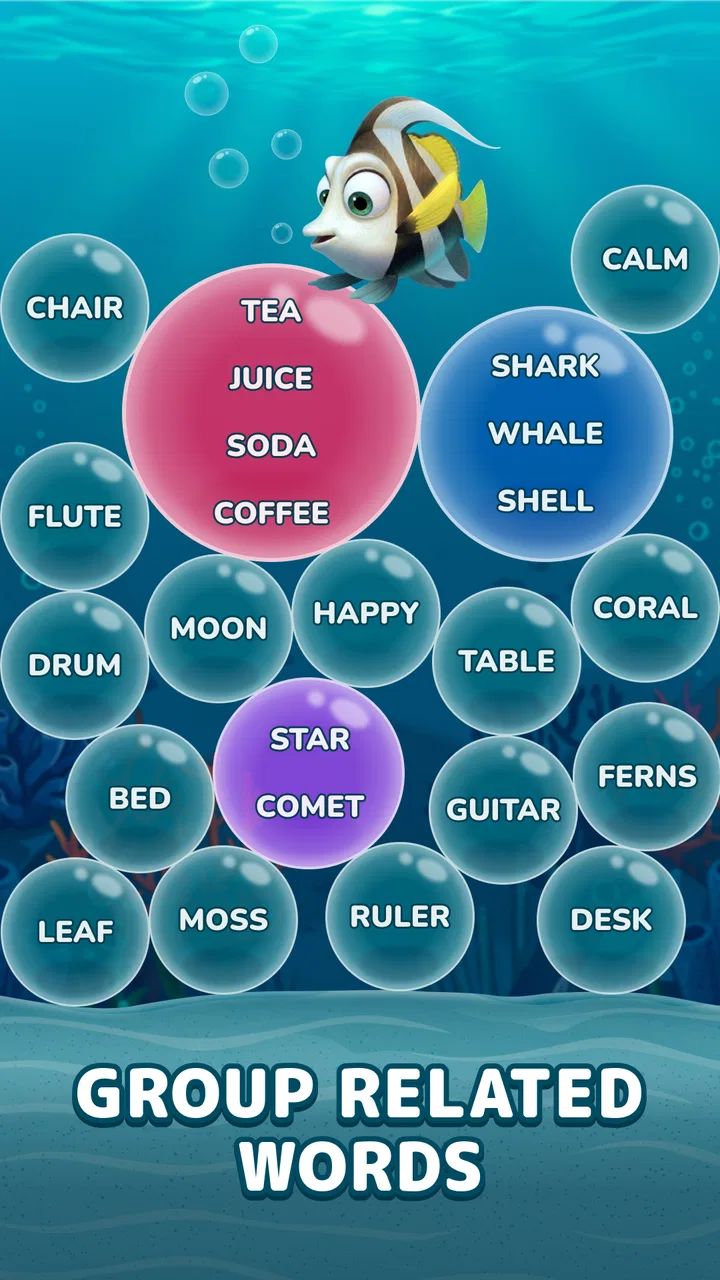
I found Bubble Associations: Word Game most interesting as a quiet, visual word puzzle rather than a traditional vocabulary test. The basic idea is easy to understand: words appear as bubbles, and I merge related ones to reveal broader categories. That makes each round feel like a small sorting exercise, with the satisfaction coming from noticing connections instead of racing against an opponent.
NewPubCo presents it as a free word game for Everyone, and that description fits the gentle, approachable character I experienced. It is the sort of game I can open for a short mental break, play without preparing anything, and put down when my attention is needed elsewhere. The free entry point is useful, although the presence of optional purchases ranging from $1.99 to $99.99 per item means I would still check the purchase settings before handing the device to a child.
How the word bubbles feel to use
I find that the bubbles do more than make the puzzle look playful: they turn word relationships into something I can scan, compare, and reconsider before committing. That visual approach is most useful when I slow down and treat the screen as a set of clues rather than a row of answers. From there, the practical question is how to make each merge thoughtfully, especially when several connections seem possible.
You May Also Like

 Blood Strike: 2.5 Anniversary
Blood Strike’s Loadouts Turn Every Drop Into a Tactical Gamble
A close look at Blood Strike’s custom loadouts: how fast access to signature weapons reshapes its battle royale rhythm, rewards preparation, and narrows the gap between fights.

 Pandora - Music & Podcasts
Pandora’s Music Is Easy to Start, but Harder to Recover
Pandora’s strength is its low-effort path from a seed to a station. Its weak spot is how much confidence it asks you to place in connection, setup, and quiet recovery.

 8 Ball Pool
 Is Built on Rivalries, Rematches, and Routine
A close look at the rivalries, rematches, shared routines, and unanswered safety questions that turn a quick pool match into a persistent mobile community.

 Samsung Music
’s Quiet Strength Is Playing What You Already Own
Its reach comes less from spectacle than from dependable access to a personal library. That simplicity is both the app’s strongest retention engine and its ceiling.

 AccuWeather: Weather Radar
AccuWeather Review: A Quick, Clear Forecast for Everyday Decisions
For everyday plans, the best forecast is the one you can understand quickly. AccuWeather makes rain timing, radar, and local conditions easy to act on, with a few trade-offs.

 Hill Climb Racing
Why Hill Climb Racing Still Turns Crashes Into One More Run
A tiny car, a bumpy hill and one more upgrade: Hill Climb Racing keeps resurfacing because its simple chaos makes every near-miss feel personal.
More From Our News Desk
View All News


Readability and navigation come before cleverness
The strongest part of the design is the direct relationship between the visible bubbles and the action I need to take. I am not navigating through a complicated maze of menus before reaching the puzzle. The central task is apparent quickly: inspect the words, look for a shared idea, and combine the ones that belong together. That simplicity matters for players who find dense game interfaces tiring or confusing.
I also like that the concept does not depend on remembering a long set of rules. A person can watch a round develop and understand the objective through the arrangement of words. For a first-time player, that lowers the learning burden. It also makes the game suitable for a shared device, because someone sitting beside me can follow the reasoning without needing a separate explanation of a complex control system.
The visual format has another advantage: it turns language into something I can scan spatially. Instead of reading a long list from top to bottom, I compare clusters and relationships across the screen. That can make the puzzle feel less demanding than a conventional crossword for someone who prefers recognition and association over writing answers into small boxes.
Still, bubble-based presentation is not automatically easy for every reader. A word game relies on being able to distinguish individual labels, and crowded arrangements can make scanning slower. I found it helpful to pause before combining anything, particularly when several terms appeared to fit the same broad theme. That pause is not wasted time; it prevents an early choice from narrowing the rest of the puzzle in an unhelpful direction.
My practical advice is to read the whole group before making the first merge. The most obvious pair is not always the best starting point. I look for words with only one convincing relationship, then use those as anchors. This approach reduces random tapping and makes the game more accessible to players who need extra time to process the choices.
Motor and sensory considerations
The interaction is built around selecting or merging bubbles, so the physical demand is lighter than in an action game. I do not need rapid reflexes, precise timing, or repeated button combinations. That makes the experience a better fit for relaxed play, especially when I am using one hand or taking a break rather than sitting in a dedicated gaming position.
Even so, a touch-based puzzle can create small frustrations for people with limited fine-motor control. If bubbles sit close together, a deliberate touch is safer than a quick swipe. I tend to hold the phone steadily, use the pad of my finger rather than the tip, and avoid playing while walking. Those habits are simple, but they reduce accidental selections and make the reasoning feel more important than the mechanics.
The game is also more visually dependent than a spoken word puzzle. The words need to be read from the screen, and their placement helps communicate which items belong in the same working area. Players with low vision may therefore find the experience more demanding, particularly if the text or contrast does not suit their needs. I would try the free version first in the device’s usual display settings rather than assuming the format will work comfortably for everyone.
For players sensitive to visual clutter, the uncluttered goal is helpful, but the bubbles can still create a busy field when several possibilities compete. I found that lowering surrounding distractions and playing in steady lighting made it easier to focus on the words. This is a good example of situational accessibility: the same puzzle can feel calm at a desk and much harder on a bright, moving screen outdoors.
Hearing is less central to the core task than sight and touch. I can reason through the word relationships without needing spoken instructions to understand the objective. That makes the game more workable in quiet public places or for someone who prefers not to rely on sound. At the same time, anyone who depends on audio cues for confirmation should test the interaction personally, because the essential information is carried by the visible puzzle rather than by a verbal explanation.
Where it fits into everyday routines
I see the best everyday use during short gaps: waiting for an appointment, sitting on a train, or taking a few minutes away from a larger task. The game does not require the emotional investment of a story campaign, and I do not need a group of friends online to make the wordplay worthwhile. It works as a private activity, but it can also become a conversation starter when two people debate whether a word belongs in one category or another.
A realistic example is a lunch break when I want something more engaging than scrolling but do not have enough time for a full game session. I can attempt a puzzle, stop when work resumes, and return later when I have another quiet moment. That flexibility is more valuable to me than a large collection of competitive features would be, because the appeal is in the individual act of making connections.
It could also suit families with different reading abilities if an adult and child solve together. The adult can read a difficult word aloud, while the child contributes the category idea. However, I would treat it as a collaborative learning activity rather than automatically calling it an educational tool. The game encourages classification and vocabulary discussion, but its main purpose remains play.
The Everyone age rating makes the game broadly approachable, yet age suitability is not identical to reading suitability. A young player may understand the merging mechanic while still finding some vocabulary difficult. In a family setting, I would use those moments as chances to explain a word instead of taking over the entire puzzle. That keeps the child involved and turns a barrier into part of the shared activity.
It is less suitable when I need a fast, high-energy distraction. Players who enjoy countdowns, competitive leaderboards, dramatic sound design, or constant action may find the deliberate word association too restrained. It is also not the right choice for someone seeking a serious language-learning course with lessons, pronunciation practice, or structured progress. Those needs call for a dedicated learning app rather than this compact puzzle format.
What separates it from usual word-game alternatives
Compared with a crossword, this game asks me to recognize relationships among supplied words rather than retrieve answers and enter them into a grid. That removes the pressure of spelling every response correctly, which can be a meaningful advantage for players who enjoy language but dislike typing or tiny crossword squares. The trade-off is that the challenge shifts toward interpretation: I may know every word and still hesitate because two categories feel plausible.
Compared with a word-search game, the focus is not on visually locating hidden strings. I am looking for meaning and grouping, so success depends more on semantic flexibility than on scanning speed. Compared with a spelling game, it is also less about constructing words and more about understanding how words relate. Those differences make it a useful alternative when conventional word games feel repetitive.
That design creates a specific kind of difficulty. A crossword usually gives me crossing letters as evidence, while a word association puzzle may offer fewer concrete clues. When I get stuck, I cannot always solve the problem by checking a letter pattern. I have to step back, question my first interpretation, and search for a less obvious connection. I consider that a strength for thoughtful play, but it can feel subjective for someone who prefers clearly verifiable answers.
One technique that helped me was to separate certainty from possibility. I first identify pairs that seem nearly undeniable, then leave ambiguous words untouched. After a confirmed group disappears or becomes clearer, the remaining terms often reveal the intended category. This is more effective than repeatedly trying the same attractive combination, and it gives players who process information slowly a structured way to continue.
Remaining barriers and practical trade-offs
The biggest barrier is the dependence on readable on-screen text. Anyone who struggles with small labels, low contrast, visual crowding, or changing focus may need to adjust the device or play in a more controlled environment. I would not recommend buying anything immediately for a player with specific access needs; the sensible first step is to try the free game on the actual phone or tablet they will use and observe whether the bubbles remain comfortable to read and select.
Vocabulary is another barrier that can be easy to underestimate. A player may understand the rules perfectly but encounter terms outside their everyday experience. That can make a puzzle feel like a test of background knowledge rather than a fair reasoning challenge. Playing with another person helps, especially when the goal is discussion rather than proving who solves the round first.
The free price lowers the risk of trying it, but optional purchases deserve attention in shared or child-focused settings. I would review the device’s purchase controls before allowing unsupervised play. The game can be enjoyed as a free download, yet the wider purchase range means the surrounding account settings are part of the practical decision for families.
Another limitation is that the game’s calm pace may not provide enough variety for players who want a large ecosystem of modes. I would choose it for its central association mechanic, not because I expect it to replace every other word game on my device. If I wanted daily competitive pressure, extensive writing practice, or a more tactile spelling challenge, I would look elsewhere. Knowing that before installing it prevents the common disappointment of asking one small puzzle game to serve several unrelated purposes.
Device context also matters. On a small phone, I would prefer to play while stationary and give myself room to inspect the bubbles. On a larger screen, the visual grouping should be easier to discuss with someone beside me, although the actual comfort will still depend on the device and the player. I appreciate that the concept supports this kind of flexible use, but I would judge the final experience by the screen in front of me rather than by the category alone.
Who should try it, and who should skip it
I would recommend it to people who enjoy categorizing words, spotting hidden relationships, and solving at their own pace. It is especially appealing if crosswords feel too dependent on spelling recall or if word searches feel too mechanical. It also works well for a parent and child, friends sharing a waiting-room distraction, or anyone who wants a small mental reset without committing to an elaborate game.
I would be more cautious about recommending it to players with significant visual-reading difficulties unless they can test the presentation comfortably first. I would also steer away from it for people who need audio-led interaction, rapid action, or formal language instruction. The game’s strengths are narrow in a good way: it concentrates on visual word association, and that focus will not satisfy every kind of player.
NewPubCo’s current version is 1.07.00, and the game supports devices running at least version 7.1 of its operating system. Those details make it worth checking compatibility before planning to use an older phone, particularly if that device is being passed to a child or family member. A smooth installation is only the first step; the more important test is whether the screen size and touch response make the bubbles comfortable to use.
My inclusive verdict
After spending time with it, I see Bubble Associations as a thoughtful word game with a low-pressure core and a clear reason to exist. Its bubble layout makes semantic connections feel tangible, while the lack of reflex-heavy play gives me time to reconsider an answer. I especially value the way it can support shared solving: one person can read, another can suggest a category, and both can participate without needing identical vocabulary.
Its inclusiveness has limits. The experience is still primarily visual, touch-based, and dependent on reading familiar or unfamiliar words from a changing arrangement. Those barriers do not make the game unsuitable, but they do make personal testing important. Lighting, screen size, visual comfort, and touch accuracy can change the experience substantially, so I would not describe it as universally accessible simply because its rules are simple.
The strong store response, with a 4.8 average from around 335 ratings and more than 10K installs, suggests that the focused concept is connecting with its audience. I treat that as encouraging rather than decisive: the right question is whether this particular style of word association matches the player’s abilities and preferences. For me, it succeeds when I want calm concentration, flexible short sessions, and a puzzle I can explain in one sentence.
My recommendation is to try it as a free, screen-focused association puzzle, not as a replacement for every word game or a full accessibility solution. If the bubbles are easy for you to read and select, the game offers a pleasant way to exercise categorization in spare moments. If you need spoken interaction, intense competition, or carefully structured language lessons, another option will serve you better. For the right player, though, its modest idea has enough depth to make a few quiet minutes feel genuinely rewarding.
FAQs for Bubble Associations: Word Game
01What is Bubble Associations: Word Game?
Bubble Associations: Word Game is a casual word puzzle that challenges you to connect related words and uncover the intended association. Instead of simply finding hidden letters, you must think about meaning, categories, and relationships between terms. Its simple bubble-based presentation makes the game approachable, while progressively more difficult puzzles provide a satisfying challenge for players who enjoy vocabulary and logic games.
02How do you play Bubble Associations: Word Game?
Gameplay generally involves examining the words or bubbles shown on the screen and selecting the ones that belong together. The objective is to identify the correct associations, complete each group, and advance through the available levels. Some puzzles may be solved quickly, while others require lateral thinking, synonyms, general knowledge, or careful attention to wording. Experimenting with possible combinations is part of the experience.
03Is Bubble Associations: Word Game free to download?
Bubble Associations: Word Game can typically be downloaded and played without an upfront purchase, although the exact availability and pricing may depend on whether you use Android or iOS. Free versions of word games commonly include optional advertisements, hint purchases, or other in-app items. Before downloading, check the store listing for current information about ads, in-app purchases, and supported devices.
04Does Bubble Associations: Word Game require an internet connection?
Whether an internet connection is required can depend on the version installed and the specific features you use. Basic puzzles may remain available offline after the game has loaded, but advertisements, cloud synchronization, updates, leaderboards, or purchases usually need connectivity. If you plan to play while traveling, test the game in airplane mode first, since offline support can vary between releases.
05Who will enjoy Bubble Associations: Word Game?
This game is a good choice for players who enjoy relaxed brain teasers, word association challenges, and short puzzle sessions. It can appeal to casual gamers as well as people looking to improve vocabulary, concentration, and flexible thinking. However, players seeking action, multiplayer competition, or highly complex strategy may find the experience too calm and repetitive, especially after extended play.
Pros
- Simple matching mechanics are easy to learn and play casually.
- Short rounds make it suitable for quick breaks or commutes.
- Colorful bubble visuals give the game a cheerful presentation.
- Progressive challenges help maintain interest over repeated sessions.
- Offline play makes it convenient when no internet connection is available.
Cons
- Some levels may feel repetitive after extended play sessions.
- Hints or extra moves may be limited without watching ads or spending currency.
- Difficulty can increase unevenly between certain stages.
- Ads may interrupt the experience
- especially after completing levels.
- Players seeking deep strategy may find the gameplay too straightforward.

Bubble Associations: Word Game
Gallery